
Lesson 5 – O: Orient Your Learning: How Do Solar Cells Turn Light into Power?
O: Orient Your Learning
What You Already Know, Pointed at a New Power Source
Before you measure anything, organize what you already know. You can already measure voltage and current with a multimeter, and you know that power is voltage times current (P = V × I). All of that carries straight over to a solar cell.
What is new is the source. A battery stores chemical energy and releases it at a fairly steady rate. A solar cell makes electricity only while light is hitting it, and the amount depends on how much light it gets. So, the same three quantities — voltage, current, and power — now describe a source that changes with its environment.
|
Quantity |
What It Describes for a Solar Cell |
Unit |
|---|---|---|
|
Voltage (V) |
The push the solar cell produces across its terminals. |
volts (V) |
|
Current (I) |
The flow of charge the cell drives when connected to a load. |
amps (A) |
|
Power (P) |
How fast the cell produces electrical energy: P = V × I. |
watts (W) |
|
Light condition |
How much light reaches the cell (brightness, angle, shading). |
described, then linked to V, I, P |
Think About It
Before you measure: if you slowly tilt a solar cell away from a light, do you expect its power to go up, go down, or stay the same? Make a prediction you can test.
Build the Background You Need
How a Solar Cell Turns Light Into Power
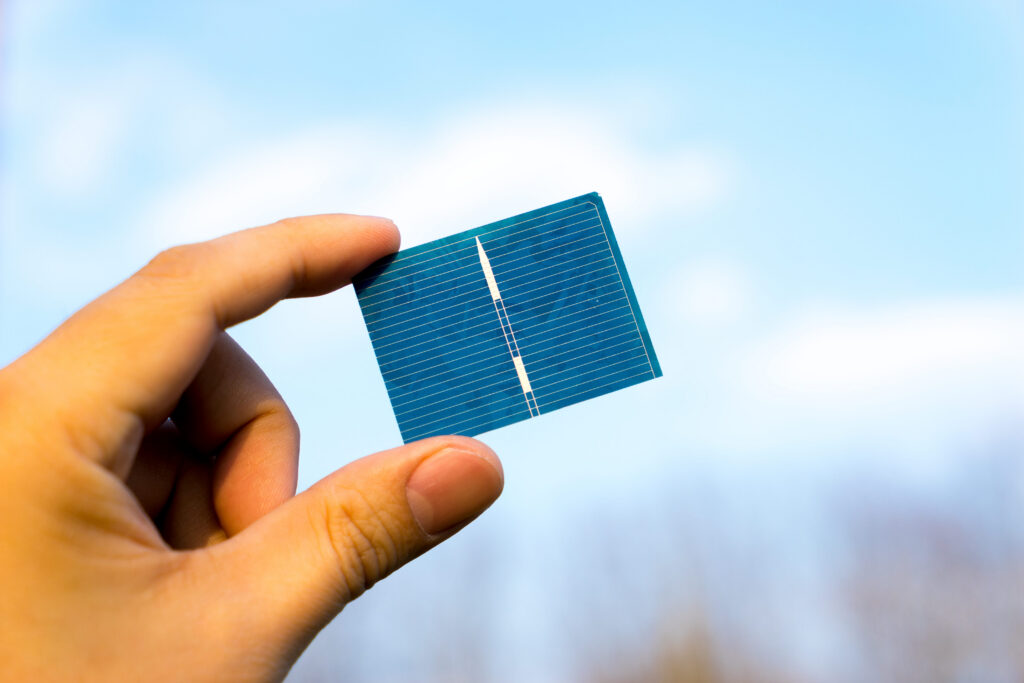
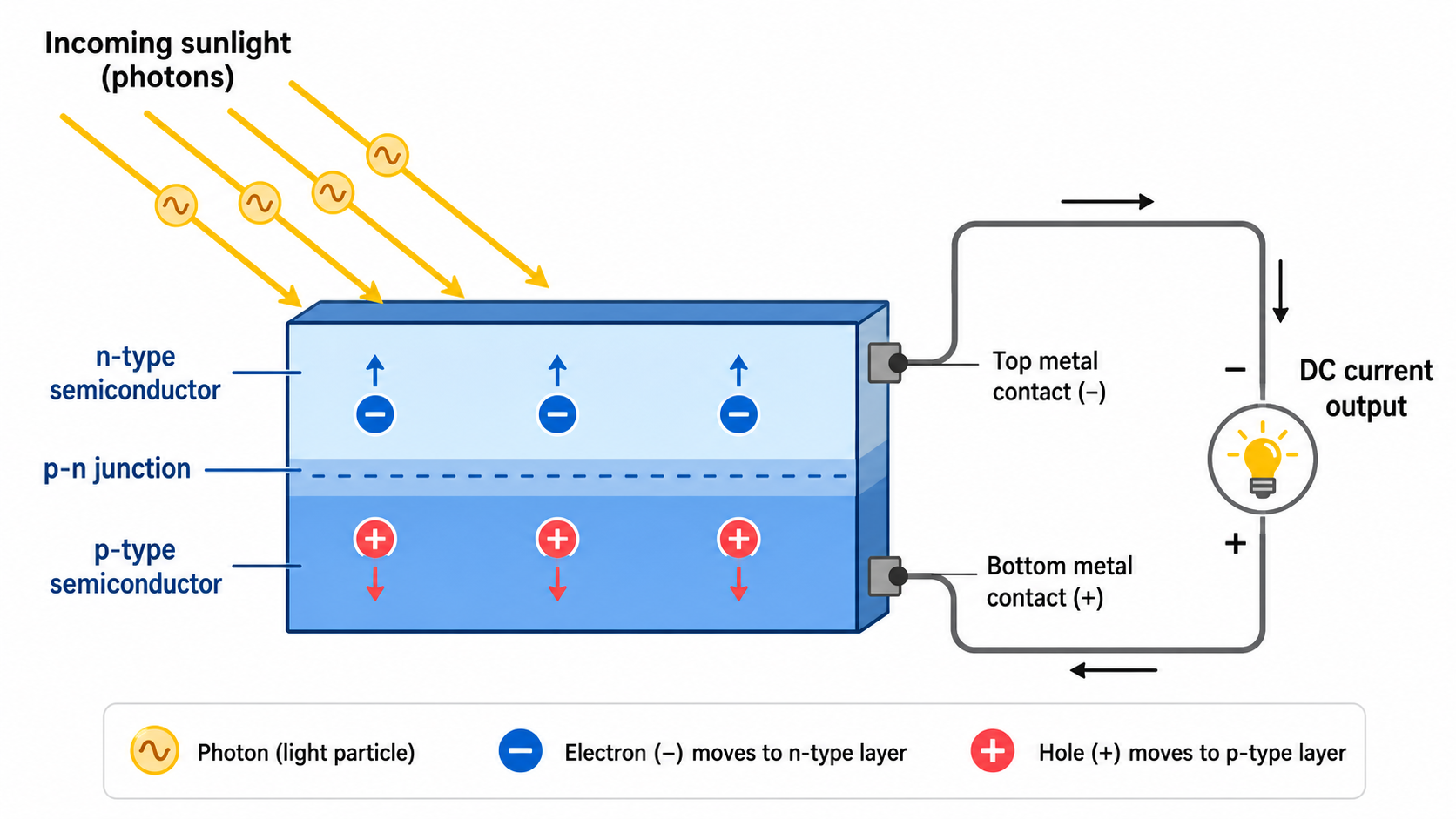
A solar cell is made of a semiconductor material, most often silicon. When light strikes the cell, it frees electrons inside the material. A built-in electric field then pushes those freed electrons in one direction, and that organized flow is a direct current (DC) in the circuit you connect to it.
You do not need the deep physics to use a solar cell well. The key idea is simple: light in → DC power out. And generally, up to the cell’s limit, the more light that reaches the cell, the more current it can drive at a given voltage — which means more power.
Key Idea
Light in → DC power out. More light reaching the cell (up to its limit) generally means more current, and therefore more power, at a given voltage.
Key Formula
Power: P = V × I (measured in watts, W)
Worked Example
Suppose in bright light your solar cell measures 4.5 V and drives a current of 120 mA. First convert 120 mA to 0.12 A. The power is:
P = V × I = 4.5 V × 0.12 A = 0.54 W
Now suppose you shade half the cell, and it drops to 4.2 V and 60 mA (0.06 A). The power becomes:
P = V × I = 4.2 V × 0.06 A = 0.25 W
Shading roughly halved the power, mostly because the current fell. That is the kind of evidence engineers use to argue how much a real panel’s output drops when conditions change. These numbers are an example — your own measurements will differ.
Safety First
You are still working with low-voltage DC circuits. Check the meter dial before every measurement: set it to DC volts to read voltage across the cell’s terminals, and to DC milliamps or amps to read current. Measure current only with a load connected, and follow your kit’s instructions for safe meter limits — do not hold the cell in a short-circuit state longer than the kit allows.