
Lesson 8 – L: Launch Your Learning: How Do Solar Systems Work?
L: Launch Your Learning
Using Component Specifications to Check Compatibility and Compare Options
You have seen that each component has a job, but engineers also need numbers to design safe, reliable systems. Specification sheets show those numbers: voltages, power ratings, efficiencies, capacities, warranties, maintenance needs, and cost.
Before recommending a system for a community, engineers ask questions such as:
- Does the battery voltage fit inside the inverter’s accepted DC input‑voltage range?
- Does the inverter have enough continuous power for typical loads?
- Does it have enough surge power to start motors or pumps?
- How efficient is the system?
- How long will the components last, and how much maintenance do they need?
- What is the upfront cost, and does that fit the budget?
Imagine This
Imagine a small community clinic wants a solar system. Engineers are comparing two possible inverter–battery pairs and need to decide which pair makes more sense for the clinic’s needs.
The clinic has these key loads:
- Exam room lights: 6 LED lights at 12 W each, used 6 hours per day.
- Waiting room fans: 2 fans at 70 W each, used 5 hours per day.
- Medicine refrigerator: about 180 W on average, running 24 hours per day.
- Phone and device charging: about 150 W for 3 hours per day.
Before looking at the specs, the engineer calculates approximate daily energy:
- Lights: 6 × 12 W × 6 h = 432 Wh
- Fans: 2 × 70 W × 5 h = 700 Wh
- Refrigerator: 180 W × 24 h = 4,320 Wh
- Charging: 150 W × 3 h = 450 Wh
Total daily demand is a little under 5,900 Wh. The refrigerator and lights are considered critical loads, because medicine has to stay cold and exam rooms need lighting.
Now the engineer looks at two possible inverter–battery pairs:
Inverter X/Battery Bank X
|
Feature |
Inverter X |
Battery Bank X |
|---|---|---|
|
Nominal DC voltage |
24 V |
24 V |
|
DC input voltage range |
21–30 V |
— |
|
Continuous rated power |
3,000 W |
— |
|
Surge power (up to 5 s) |
6,000 W |
— |
|
Usable capacity |
— |
6 kWh |
|
Round‑trip efficiency |
Moderate |
Moderate |
|
Estimated lifetime |
5 years |
5–7 years |
|
Maintenance |
Basic monitoring; standard care |
Regular checks; more hands‑on |
|
Approximate up‑front cost |
Lower |
Lower |
Summary: Inverter X accepts 24 V DC input and can supply 3,000 W of continuous AC power with 6,000 W surge. Battery Bank X is a 24 V bank with usable capacity of 6 kWh and moderate efficiency. The warranty is 5 years; maintenance is simple but needs regular checks. Upfront cost is lower.
Inverter Y/Battery Bank Y
|
Feature |
Inverter Y |
Battery Bank Y |
|---|---|---|
|
Nominal DC voltage |
48 V |
48 V |
|
DC input voltage range |
42–60 V |
— |
|
Continuous rated power |
5,000 W |
— |
|
Surge power (up to 5 s) |
9,000 W |
— |
|
Usable capacity |
— |
8 kWh |
|
Round‑trip efficiency |
Higher |
Higher |
|
Estimated lifetime |
10 years |
10–15 years |
|
Maintenance |
More advanced monitoring; minimal |
Minimal routine maintenance |
|
Approximate up‑front cost |
Higher |
Higher |
Summary: Inverter Y accepts 48 V DC input and can supply 5,000 W of continuous AC power with 9,000 W surge. Battery Bank Y is a 48 V bank with usable capacity of 8 kWh and higher efficiency. The warranty is 10 years; maintenance is minimal.
What Do Engineers Consider?
Engineers take into account many considerations when deciding what is the correct fit for their scenario, and most of the time there is not a clear decision, rather you could come to multiple conclusions depending on the evidence and priorities. Some things an engineer would do in this scenario would be:
- Check voltage compatibility (X with X, Y with Y).
- Compare continuous power and surge power against the clinic’s loads.
- Look at usable capacity, efficiency, lifetime, maintenance, and cost to decide which pair better fits clinic priorities.
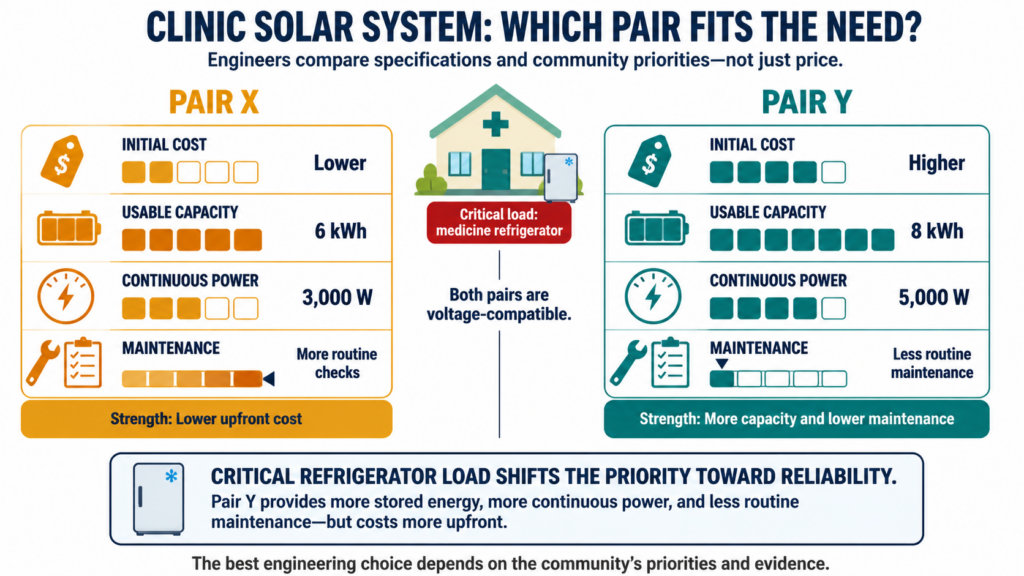
In this example, the engineering team decided that Pair Y is the stronger fit. This is why:
- The clinic’s daily demand is a little under 5,900 Wh, and the refrigerator and lights are critical loads that must stay on reliably. Pair Y offers higher usable capacity (8 kWh) and higher efficiency, which gives more stored energy and less loss in the system, making it better for long or cloudy periods when solar input is low.
- Pair Y’s inverter has higher continuous power (5,000 W) and surge power (9,000 W) than Pair X, so if the clinic adds more equipment later or needs to start a motor or pump, the system is more likely to handle those loads without tripping.
- Pair Y has a longer warranty and less routine maintenance, which matters for a clinic where staff may have limited time or technical training to service batteries and equipment.
The trade‑off is that Pair Y has higher up‑front cost, so the clinic would be accepting more initial spending to gain reliability, capacity, efficiency, and lower maintenance over time. In a health context where keeping medicine cold and lights on is critical, that trade‑off is easier to justify than it would be for a less critical site.
Think About It
Why might one community choose the lower-cost battery with more maintenance, while another chooses the higher-cost battery with higher efficiency and longer lifetime?