
Lesson 8 – O: Orient Your Learning: How Do Solar Systems Work?
O: Orient Your Learning
Understanding What Jobs Each Part of a Solar System Completes
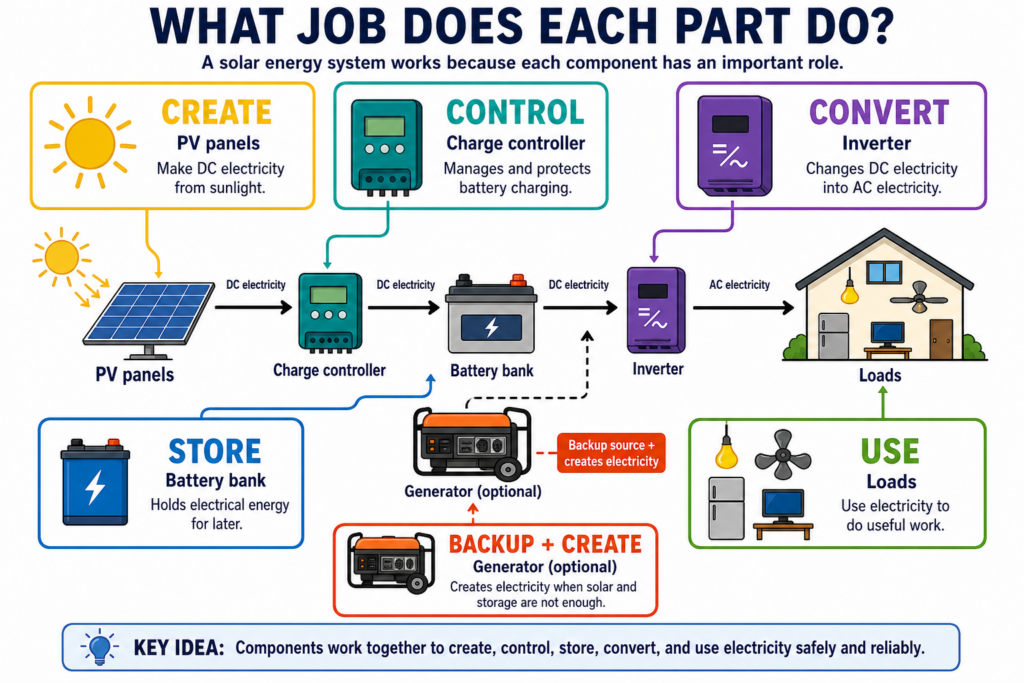
Seeing the diagram is only the first step. To design or troubleshoot a solar system, engineers must know what job each component does in the system. Some parts create energy, some store it, some control its flow, some convert it from DC to AC, some act as backup sources, and some use the energy.
A helpful way to think about the system is to sort components by their main functions rather than just their names. For example, panels are the “create” part, batteries are part of the “store” part, and loads are the “use” part. The charge controller controls how energy moves into and out of the batteries, and the inverter converts DC into AC so that common devices can use it. A generator might serve as backup when the sun is not available or demand is very high.
Function Words
These function words can describe what each component’s job is:
- Create – Make electrical energy from another source (like sunlight).
- Control – Manage and protect the flow of energy.
- Store – Hold energy for later use.
- Convert – Change energy from DC to AC or adjust voltage.
- Use – Take in electrical energy to do work (like turning on a light or running a fridge).
- Backup – Provide energy when the main source or storage is not enough.
Think About It
What component in your table has more than one function word? Why might a component with multiple roles be especially important for keeping the system reliable over time?