Lesson 8 – V: Voyage into Volt: How Do Solar Systems Work?
V: Voyage Into Volt
Connecting a Simple Circuit to a Full Solar Energy System
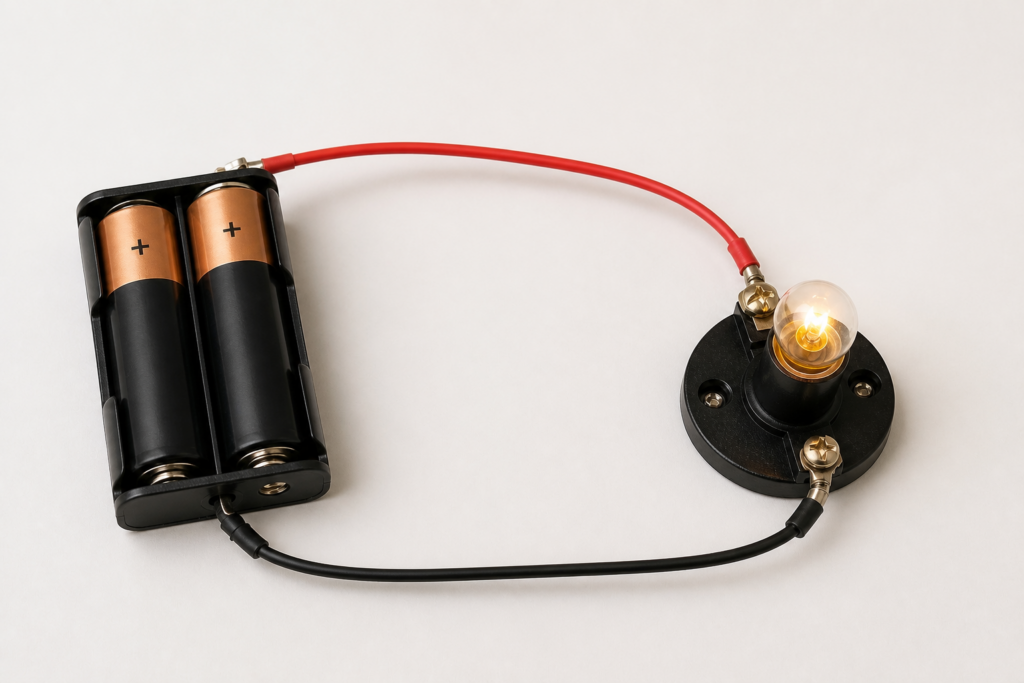
You already know what a basic circuit needs: a source of electrical energy, conductors to carry current, a load that uses the energy, and a return path to close the loop. If any part of that loop is missing, current cannot flow safely and the circuit will not work.
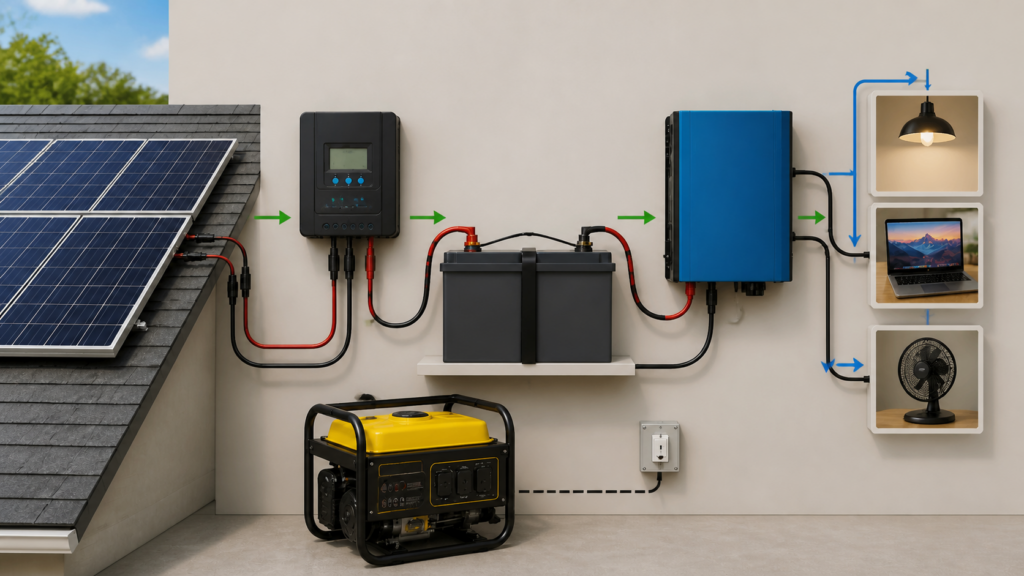
A solar energy system is more complicated than a single battery and lamp, but it is still built from the same idea of a complete path. Instead of one source, it can have several: panels, batteries, and sometimes a generator. Instead of one simple load, it can power lights, fans, refrigerators, computers, pumps, and more. Engineers add extra components, such as a charge controller and an inverter, to control and convert energy so that it is safe and useful for everyday devices.
Comparing Two Diagrams
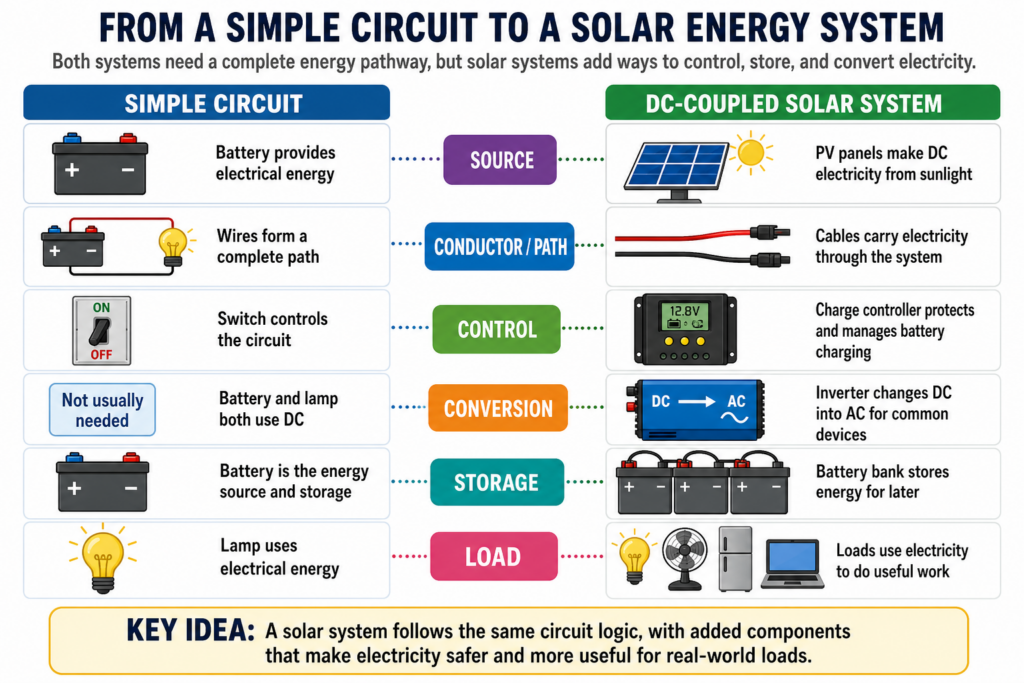
You will now compare a simple circuit diagram with a DC‑coupled solar system diagram.
Think About It
In both these systems the source is… (What starts the energy flow in each diagram?)
In the solar system, the inverter replaces the simple battery-to-lamp connection in a basic circuit because… (Why do homes and schools need AC instead of only DC?)
A simple circuit and a solar energy system might look very different, but they both start with a source that provides electrical energy. In a basic circuit, that source is usually a battery that pushes charges through the wires toward a single load, like a lamp. In a solar system, the source role is shared: panels make DC electricity from sunlight and the battery bank stores that energy so it can keep supplying power even when the sun goes down. In both cases, nothing else in the diagram works unless the source is able to provide energy and the path is complete.
Solar systems add more components than a simple battery‑to‑lamp setup because real‑world systems have to do more than power one small device. They must protect batteries from damage, keep voltages safe, and deliver the right kind of power for everyday equipment. The charge controller manages how energy flows into and out of the batteries so they are not overcharged or drained too far. The inverter changes DC from panels and batteries into AC at the correct voltage and frequency so lights, refrigerators, computers, and other common loads can use it. An optional generator can step in as backup when solar and storage are not enough. All of these “extra steps” make the system safer, more reliable, and more useful for homes, schools, and businesses over time.