
Lesson 8 – T: Transform Your Learning: How Do Solar Systems Work?
T: Transform Your Learning
Making a Design Recommendation and Explaining a Trade-Off
A pair of components can be technically compatible and still not be the best choice for a particular community. A rural clinic may care most about reliability and lifetime, while a small shop may care most about surge power and efficiency, and a home may care most about budget and basic lighting. Engineers use priorities plus specifications to make evidence‑based decisions.
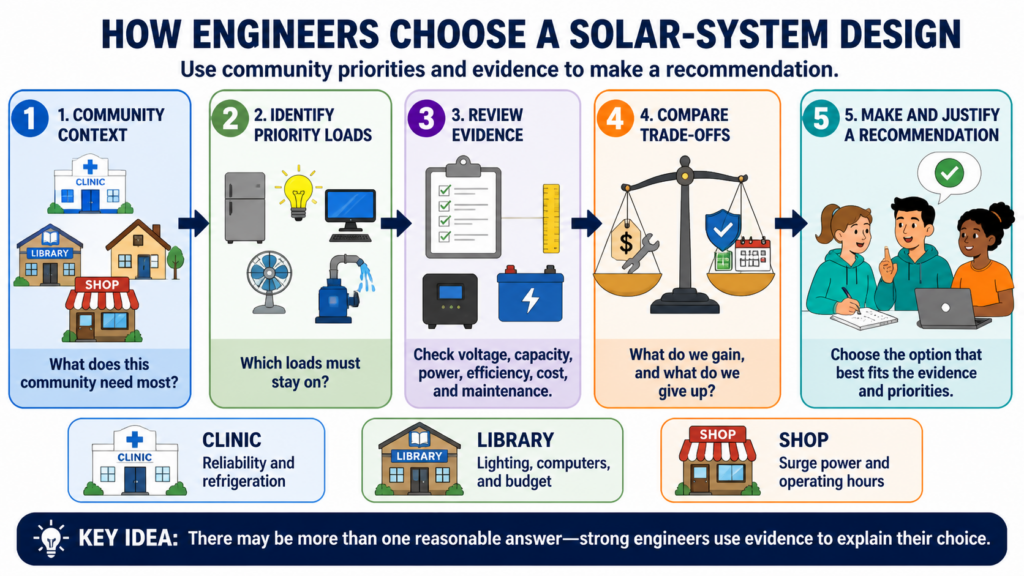
Take a look at an example.
Example: Community Library
Imagine a small community library that wants to run its main equipment with solar power. It has lights in the reading area, a few computers, a Wi‑Fi router, and a small fridge. To see how much energy the library needs each day, engineers make a load profile. They list each device, how much power it uses, and how many hours it runs. For example, six LED lights at 12 watts for six hours use 6 × 12 × 6 = 432 watt‑hours. Two computers at 150 watts for four hours use 1,200 watt‑hours. When they add the lights, computers, router, and fridge, the library uses a little under 5,900 watt‑hours per day.
Next, they compare this daily demand to the solar system’s daily supply. If the panels can provide about 7,000 watt‑hours on a typical day, that is more than the 5,900 watt‑hours the library needs, so the system should be able to power all the loads most days. However, engineers still think about cloudy days and which loads are most important. For a library, lights and computers are usually priority loads because they support reading and homework. The fridge is helpful, but if energy is limited, it might be the first thing to turn off.
Finally, engineers choose between different inverter–battery pairs. One pair might be cheaper but store less energy and need more maintenance. Another pair might store more energy, work more efficiently, and last longer, but cost more. Both might be technically able to run the library. The decision is about trade‑offs: the library might accept higher cost to gain better reliability, or accept more maintenance to save money. The “right” choice depends on what the library cares about most.
Engineering Notebook
Check Your Understanding
- Describe the sequence of components in a DC‑coupled solar system and the role of each: panels → charge controller → battery → inverter → loads, plus optional generator.
- Explain why matching inverter input voltage and battery bank voltage is necessary for safe, effective operation.
- Name two inverter parameters and two battery parameters that influenced your design choice, and describe one trade‑off your group accepted.
Closure: Connecting Lesson 8 to Lesson 9
In this lesson, you connected simple circuits to full solar systems, learned the job of each component, and used specification sheets to make an evidence‑based recommendation for a real‑world context. You also saw that engineers must balance priorities and trade‑offs. There is rarely a single “perfect” option, only choices that fit some needs better than others.
In the next lesson, you will apply this system‑level thinking and your decision‑making process to build a class mini‑grid, using the components and energy-flow sequence from this unit.
Final Takeaway
A solar energy system is more than just panels. It is a whole circuit made of parts that create, control, store, convert, and use electrical energy so power is safe and reliable for many different loads. Engineers use diagrams, load profiles, and specification sheets to check that components are compatible and to choose inverter–battery pairs that fit a community’s priorities, even when that means accepting trade‑offs.