
Lesson 6 – L: Launch Your Learning: How Do We Build and Use Photovoltaic Panels?
L: Launch Your Learning
Build and Compare Mini-Panel Models
Now you will use what you already know about voltage, current, and power to understand how a full photovoltaic panel is built from many smaller cells. In class, you may model this with real cells or with cell cards that list voltage and current values. Either way, the goal is the same: notice how the way cells are connected changes the electrical output of the panel.
A photovoltaic panel is not just one cell made larger. It is a set of cells connected on purpose so the panel can provide the kind of output a system needs. When engineers choose how to connect cells, they are deciding whether the system needs more voltage, more current, or a balance of both.
Series and Parallel Connections
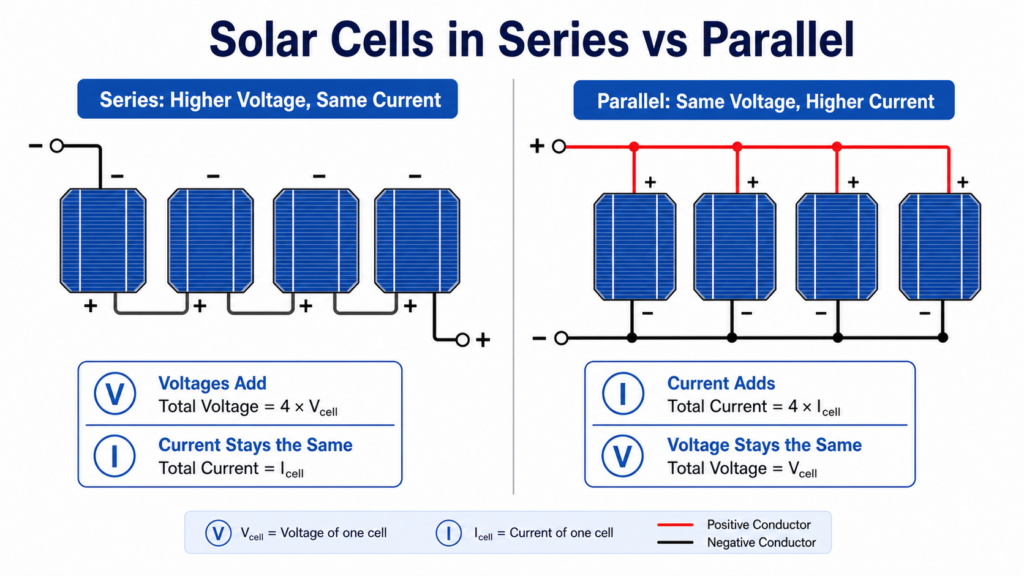
A series connection adds voltage while keeping current about the same. A parallel connection adds current while keeping voltage about the same. Power still depends on both quantities, so you can compare setups by calculating P = V x I from the voltage and current in each one.
This is why two setups built from the same small cells can behave differently. One arrangement may be better when a system needs higher voltage, while another may be better when a system needs higher current.
Worked Example
Suppose one solar cell produces 0.5 volts and 0.2 amps. If two cells are connected in series, the voltages add and the current stays about the same. That gives about 1.0 volts and 0.2 amps, so the power is 0.20 watts.
P = 1.0 V x 0.2A = 0.20 W
If two cells are connected in parallel, the currents add and the voltage stays about the same. That gives about 0.5 volts and 0.4 amps, so the power is also 0.20 watts.
P = 0.5 V x 0.4 A = 0.20 W
Even though the power is the same in this simple example, the output is not the same. The series setup provides more voltage, and the parallel setup provides more current. That difference matters because real devices and systems may need one kind of output more than the other.
Pause and Think
- Which kind of connection changes voltage more?
- Which kind of connection changes current more?
- Why might two setups with similar power still be useful for different jobs?
- What does this help you understand about how real photovoltaic panels are designed?
Key Idea
A photovoltaic panel is built by combining many solar cells. The way the cells are connected changes how much voltage and current the panel can produce, and that helps engineers match the panel to the needs of a real system.