
Lesson 4 – O: Lesson 4: How Do I Build a Circuit and Calculate Power & Energy?
O: Orient Your Learning
What You Already Know About V, I, R, Power, and Energy
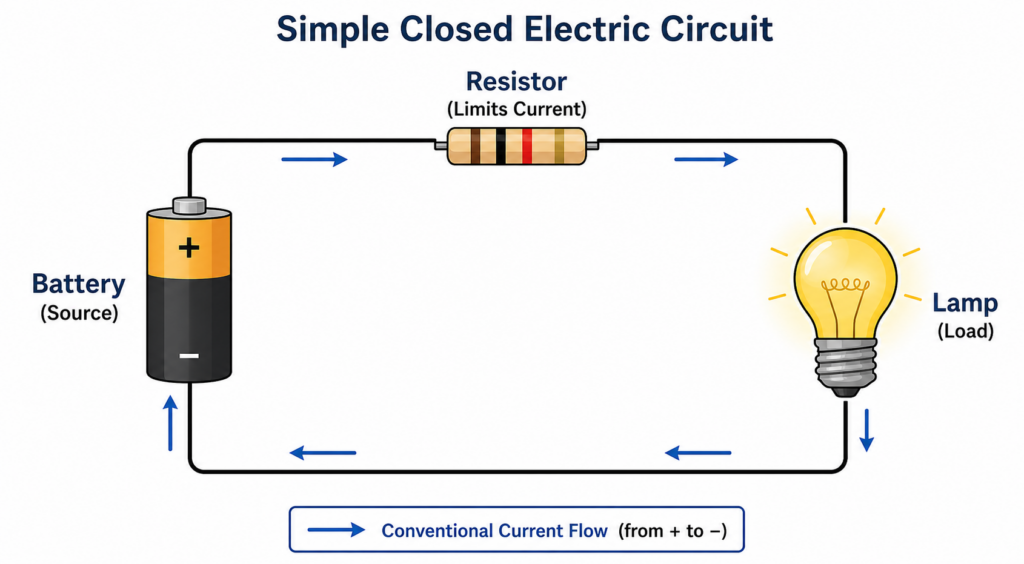
Before you build anything, it helps to organize what you already know. You have already worked with two of the three key quantities: voltage (the push) and current (the flow). The third quantity, resistance, describes how much a component slows the current down.
You also have an everyday sense of the words “power” and “energy,” but in circuits they have exact meanings. Power is how fast energy is used right now. Energy is the total amount used over a stretch of time. A bright light uses more power than a dim one; a light left on all day uses more energy than the same light on for a minute.
|
Quantity |
What It Describes |
Unit |
|---|---|---|
|
Voltage (V) |
The electrical push across a component. |
volts (V) |
|
Current (I) |
The flow of electric charge through the circuit. |
amperes (A) or milliamps (mA) |
|
Resistance (R) |
How much a component opposes the current. |
ohms (Ω) |
|
Power (P) |
How quickly electrical energy is being used. |
watts (W) |
|
Energy |
Power used over time. |
watt-hours (Wh), kilowatt-hours (kWh) |
Think About It
Two lamps run on the same voltage, but one is brighter than the other. Which one do you think draws more current — and why might that matter when you plan how long it can run?
Build the Background You Need
Ohm’s Law, Power, and Energy
Ohm’s Law is the relationship that connects voltage, current, and resistance. It says the voltage across a component equals the current through it multiplied by its resistance.
Key Formula
Ohm’s Law: V = I × R
Because the three quantities are linked, if you know any two of them you can find the third. That is what makes Ohm’s Law useful for design, not just description. If you rearrange it, you get two more forms you will use:
|
If You Want to Find… |
Use This Formula |
What It Lets You Do |
|---|---|---|
|
Voltage (V) |
V = I × R |
Predict the push across a component you already chose. |
|
Current (I) |
I = V ÷ R |
Choose a resistor that gives you a target current. |
|
Resistance (R) |
R = V ÷ I |
Find the resistance that produces a current you measured. |
Once a circuit is running, you can describe how hard it is working. Power tells you how quickly the circuit is using energy. It is the voltage multiplied by the current.
Key Formula
Power: P = V × I
(measured in watts, W)
Energy connects power to time. A device that uses more power, or runs longer, uses more energy. You find energy by multiplying power by the number of hours it runs.
Key Formula
Energy: energy = power × time
(watts × hours = watt-hours, Wh)
1,000 Wh = 1 kWh
Worked Example
Suppose you build a circuit with a 5 V source that draws 100 mA of current. First convert milliamps to amps by dividing the mA/1000.
Example:
100 mA = 100 mA/1000 = 0.1 A.
The power is:
P = V × I = 5 V × 0.1 A = 0.5 W
If that circuit runs for 3 hours, the energy it uses is:
Energy = Power × Time = 0.5 W × 3 h = 1.5 Wh
So, this small circuit uses half a watt of power and one and a half watt-hours of energy over three hours. Those are exactly the kinds of numbers an engineer adds up to size a system.
Safety First
You will work with low-voltage DC circuits only. Always check the meter dial before each measurement: volts are measured across a component, current is measured in series (in the loop), and resistance is measured only on a component with the power off. Never measure resistance on a powered circuit, and never leave a circuit in a short-circuit state.