
Lesson 2 – V: Voyage into Volt: How Do Electrical Circuits Work Safely?
V: Voyage Into Volt
Why a Working Circuit Needs a Complete Path
Electricity Needs a Path
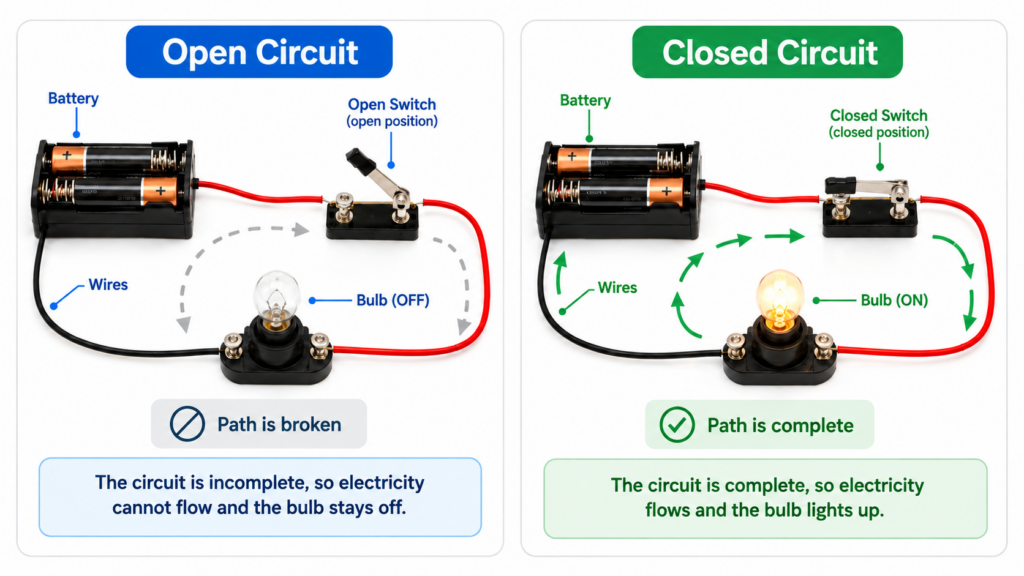
Electricity does not move through a random pile of parts. Current flows only when the parts create a complete path, known as a closed circuit. A closed circuit is a complete pathway that allows electric current to move from an energy source, through electrical components, and back to the source. In a simple battery-powered circuit, the source is the battery, conducting wires provide the path, a switch can control the path, and a load, such as a light bulb, LED, buzzer, or motor, uses electrical energy to produce light, sound, motion, or heat. A closed circuit has an unbroken loop from one battery terminal, through the wires and load, and back to the other battery terminal, so current can flow and the load can operate. An open circuit has a gap somewhere in that loop, such as an open switch, a disconnected wire, or a loose connection, so current cannot complete the path and the load stays off.
A short circuit is different: the circuit may be complete, but current takes an unintended, very low-resistance route that bypasses the intended load or connects the source terminals too directly. For example, placing a wire directly between the positive and negative terminals of a battery creates a shortcut rather than sending current through an LED and its resistor. This can cause excessive current, heating, battery drain, or damage, so you should explore short circuits only in a simulation, not with real batteries or wires.
|
Circuit Situation |
What Happens |
Why It Matters |
|---|---|---|
|
Closed circuit |
The bulb lights. |
Current has a complete path through the bulb and back to the battery. |
|
Open circuit |
The bulb does not light. |
A break or gap in the path stops current from flowing. |
|
Different layout |
The bulb can still light. |
The shape of the circuit can change, but the path must still be complete. |
PhET Circuit Challenge
Think About It
Use the linked PhET simulation to do the following:
- Build a working battery–wire–bulb circuit.
- Add a switch. Open and close the switch to compare what happens with the bulb and current flow.
- Remove one wire or create a gap to model an open circuit.
Key Discovery
What does electricity need in order to move?