
Lesson 1 – T: Transform Your Learning: Why Electricity Matters Around the World
T: Transform Your Learning
Show What You Can Do and Connect It Forward
Two Ways Communities Can Receive Electricity
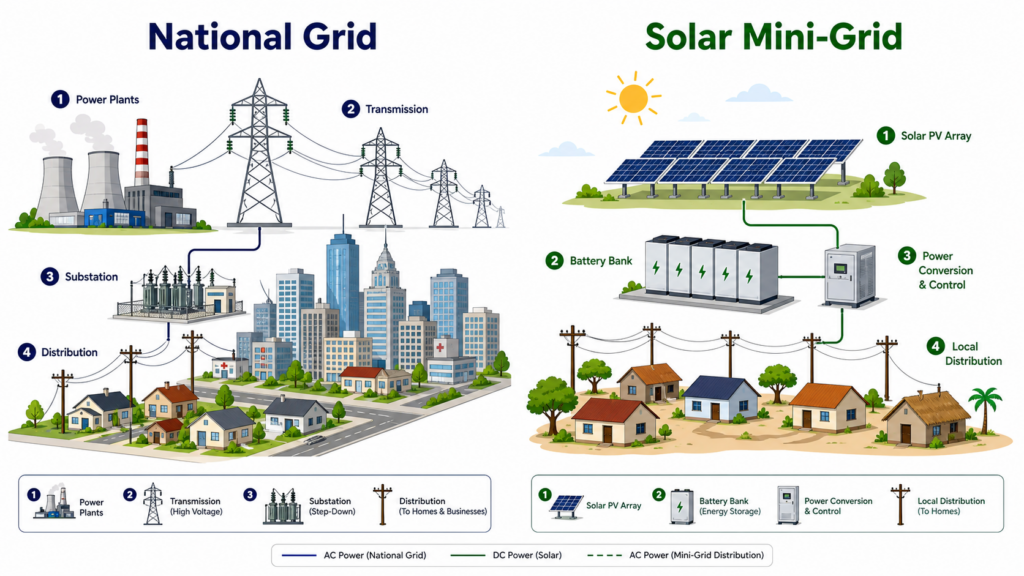
Communities can get electricity in different ways. Two main ways of getting electricity are through a national grid and a mini-grid. The best choice for a community depends on the place and the people who live there.
|
Electricity Model |
What It Means |
Why a Community Might Choose It |
|---|---|---|
|
National Grid |
A large connected electricity system that sends power over long distances from central power sources to many users. |
It can serve large populations and support big infrastructure, but it often costs a lot to build and expand. |
|
Mini-Grid / Local System |
A smaller electricity system that serves a village, neighborhood, clinic, school, or local area. |
It can be faster to set up in remote places, but it may require local maintenance and planning for storage or backup power. |
Criteria for Selecting an Electricity Model
There are different criteria that go into selecting the best electricity model for a community. Depending on the stakeholder, different criteria will be more or less important when making a decision on an electricity model. There is rarely a solution that treats all criteria as equal, and most times there are trade-offs. A trade-off is a choice where you gain one thing but may give up another.
|
Criterion |
Question to Ask |
|---|---|
|
Cost |
How much will it cost to build, use, and fix? |
|
Reliability |
Will people have power when they need it? |
|
Environmental Impact |
How will it affect air, water, land, and climate? |
|
Scalability |
Can it grow if the community grows? |
|
Health Impact |
How well does it support clinics, water, safety, and daily health? |
Key Idea
A trade-off does not mean a choice is bad. It means each choice has strengths and limits.
Comparing a National Grid to a Mini-Grid/Local System
|
Criterion |
National Grid |
Mini-Grid / Local System |
|---|---|---|
|
Cost |
High upfront infrastructure cost; economies of scale over time. |
Lower upfront cost; can be implemented faster; ongoing maintenance costs. |
|
Reliability |
Dependent on centralized infrastructure, outages affect large areas. |
Localized; failure affects fewer people; can integrate storage. |
|
Environmental Impact |
Depends on energy source; fossil-fuel plants have high emissions. |
Often uses renewables such as solar or wind; lower emissions in operation. |
|
Scalability |
Easily expanded as demand grows across large regions. |
Harder to scale beyond the local community without major redesign. |
|
Health Impact |
Broad access supports hospitals and water treatment at scale. |
Can prioritize clinics and water pumps; faster deployment in remote areas. |
Think About It
Which electricity model, a National Grid or a Mini-Grid, seems stronger for each criterion and why?
Role Impacts Recommendation
Because different stakeholders have different wants and needs, they would likely recommend a different electricity model based on those needs. To defend their recommendation, they would include a claim, evidence, reasoning and any trade-offs they would make.
|
Part |
What to Include |
Example Starter |
|---|---|---|
|
Claim |
Say which solution may be better. |
From my role, the stronger choice may be… |
|
Evidence |
Use a lesson idea, criterion, or example. |
This matters because… |
|
Reasoning |
Explain how your evidence supports your claim. |
This connects to… |
|
Trade-off |
Name one challenge or limit. |
One trade-off is… |
Think About It
From the lens of different roles, what are some ideas they care about, and from your role what question might you have for them? Does your thinking change after considering other roles?
Real-World Connection
Electricity Choices Need Evidence and Trade-Offs
Real communities often make energy choices with limited money, time, and materials. Engineers can design power systems, but the best design must also fit the people and the place.
This is why community voices matter. It is also why facts matter. A good power plan should be useful, safe, reliable, affordable, and right for the local area.
Closure: Connecting Lesson 1 to Lesson 2
In Lesson 1, you looked at why electricity matters and why it is important to different stakeholder groups. You also compared two ways a community can get power: 1. a national grid and 2. a mini-grid, or local power system.
In Lesson 2, you will learn that current needs a complete path to move and needs a controlled path to move safely. You will compare closed circuits, open circuits, short circuits, switches, and resistance. You will also learn Ohm’s Law to see how resistance affects current.
Check Your Understanding
- Why is electricity important for communities? Mention at least two reasons.
- Name two different ways communities can get electricity.
- From your role’s perspective, which solution, national grid or mini-grid, might be better for a specific community, and why? Mention at least one criterion: cost, reliability, or environment.
Final Takeaway
Electricity access is a real-world engineering problem. Communities need power solutions that fit their needs, place, and resources.